
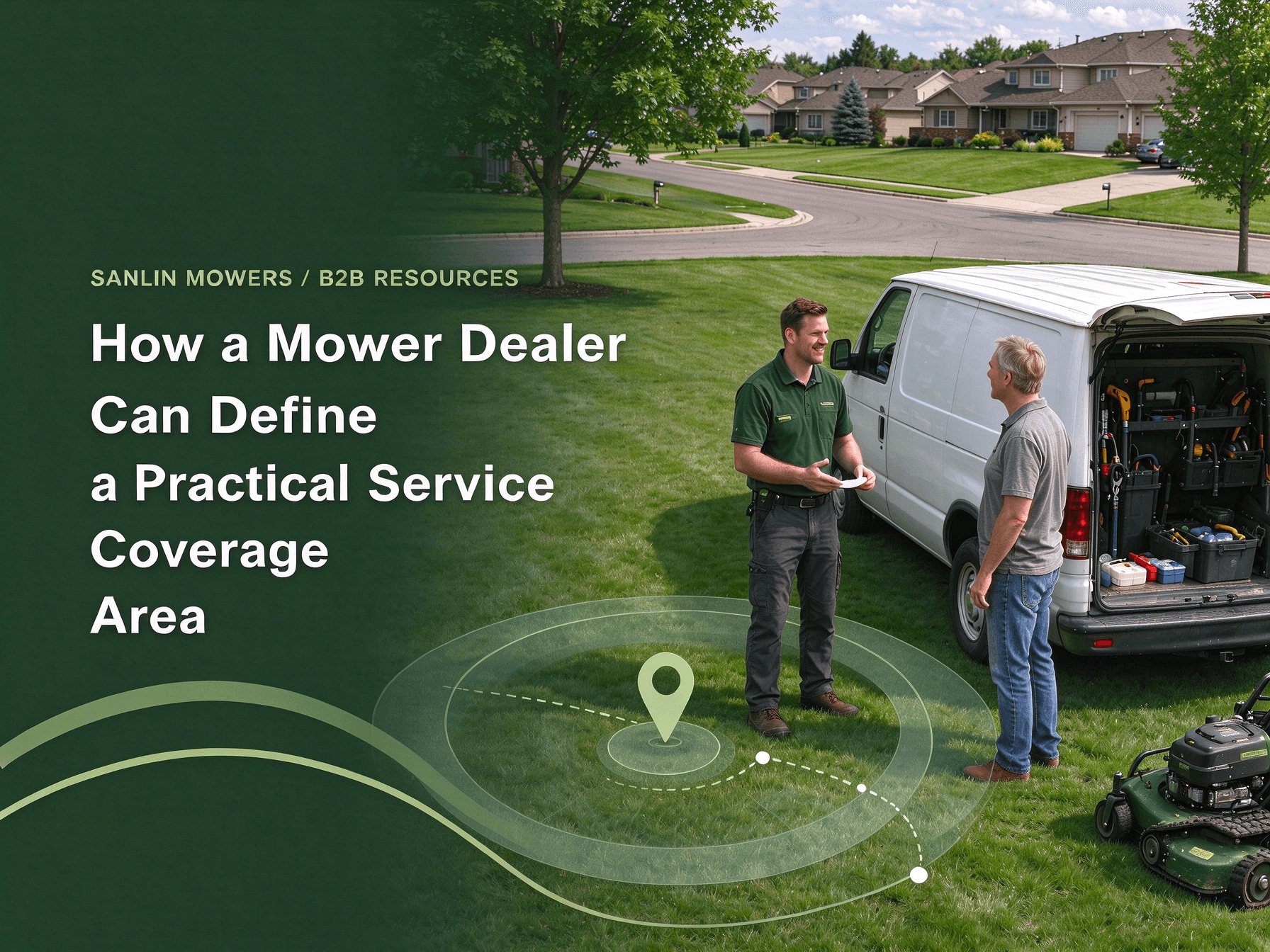
Map customers before drawing a service boundary
A dealer should define service coverage based on the customers and machines it expects to support, rather than beginning with an attractive radius on a map. List likely customer locations, the proposed models and configurations, the number of units under discussion, and the kind of work those units will perform. Distinguish a showroom customer from a contractor operating across several sites. A single distance figure can conceal difficult travel routes, limited workshop access, or a machine that must be examined where it works. Record these differences as assumptions to check before stating any service promise.
Use the public product range to identify candidate models, then ask what maintenance information and parts identifiers apply to each selected configuration. A product page is a useful starting point, but it cannot tell a dealer which local tasks its own technicians can perform. If the model mix remains provisional, label the coverage map provisional as well. A practical first output is a list of customer clusters and machines, with the responsible local contact for each. That list is more useful than an unsupported claim that the dealer covers an entire country.
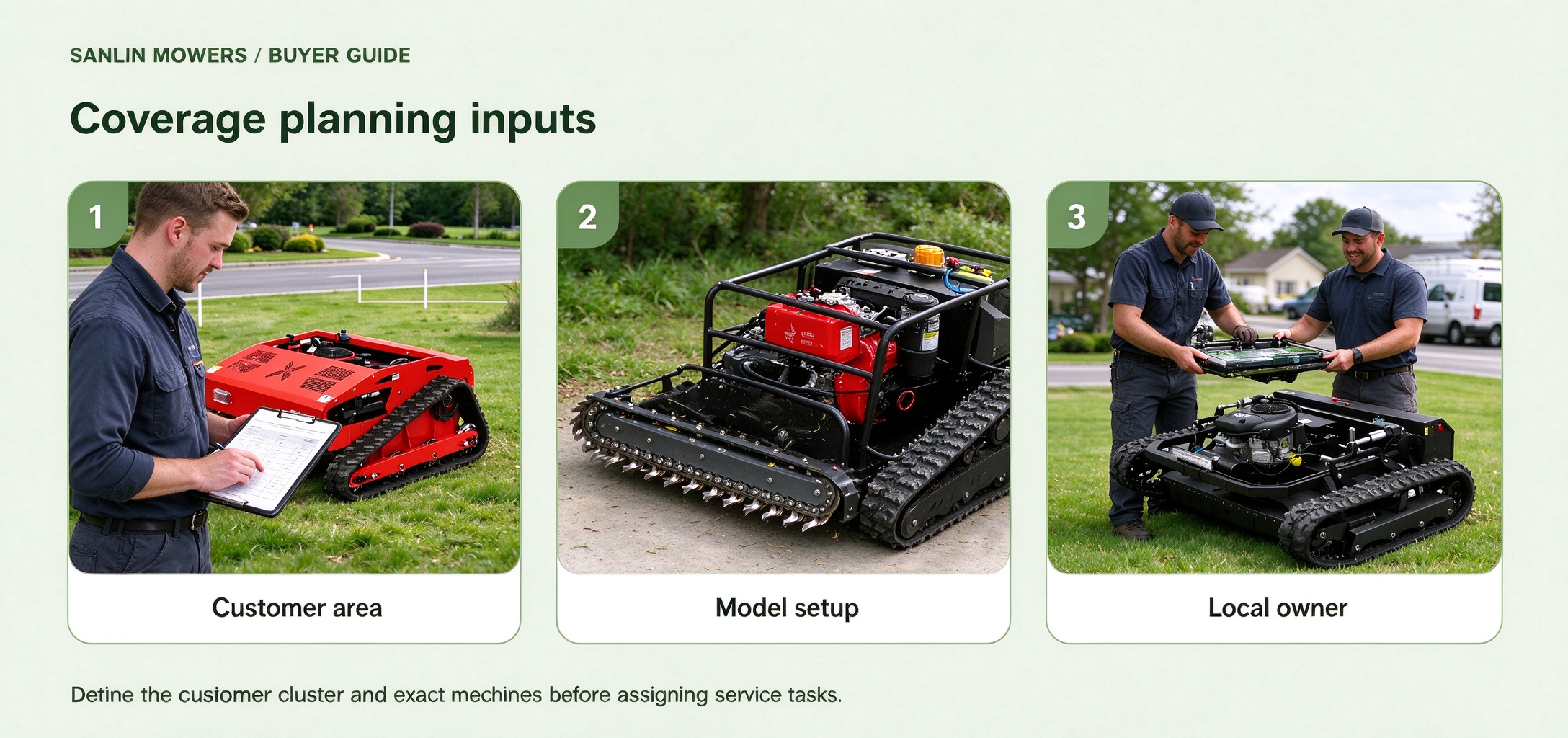
Define the customer cluster and exact machines before assigning service tasks.
Separate response channels from service capability
Customers may need help identifying a part, understanding an instruction, arranging an inspection, or obtaining a repair. These are different requests and should not all be called service coverage. Write down which questions the dealer can answer remotely, which tasks can be handled in its workshop, which might require a site visit, and which need a qualified specialist or supplier review. Do not infer that every issue can be resolved through the same channel. The dealer should know who receives each kind of enquiry and what information must accompany it before quoting a response arrangement.
The buyer guide on remote-control tracked mower selection calls for questions about routine maintenance, wear parts, technical information, and after-sales communication. Turn those questions into a capability table for the exact models being considered. For each task, note the relevant instruction, available skills, tools, parts, and owner. Leave a task unassigned if the local team cannot yet demonstrate a suitable process. The table describes what the dealer has verified internally; it does not create a supplier commitment or authorize an operator to work outside the applicable instructions.
Test the plan against real travel and parts scenarios
Choose two or three representative customer locations and walk through a hypothetical enquiry from first contact to a documented next step. Can the dealer identify the unit and configuration? Who reviews the symptoms and the instructions? Where would the unit be examined, and how would a needed part be identified? A scenario that depends on an unspecified vehicle, technician, or stock item remains a gap. This exercise helps separate a plausible service plan from a marketing statement, without inventing a fixed response time or assuming that all faults are alike.
Record travel constraints, workshop capacity, and part-ordering questions for each scenario. If the dealer is considering a wider territory, repeat the exercise for its most difficult location, not only its nearest customer. Ask the supplier to clarify the model-specific documents and support contact needed to assess open questions. The dealer then decides whether to narrow its initial territory, add a confirmed partner arrangement, or defer a customer commitment. Those are planning choices for the dealer and must be checked against the actual commercial agreement before being offered publicly.
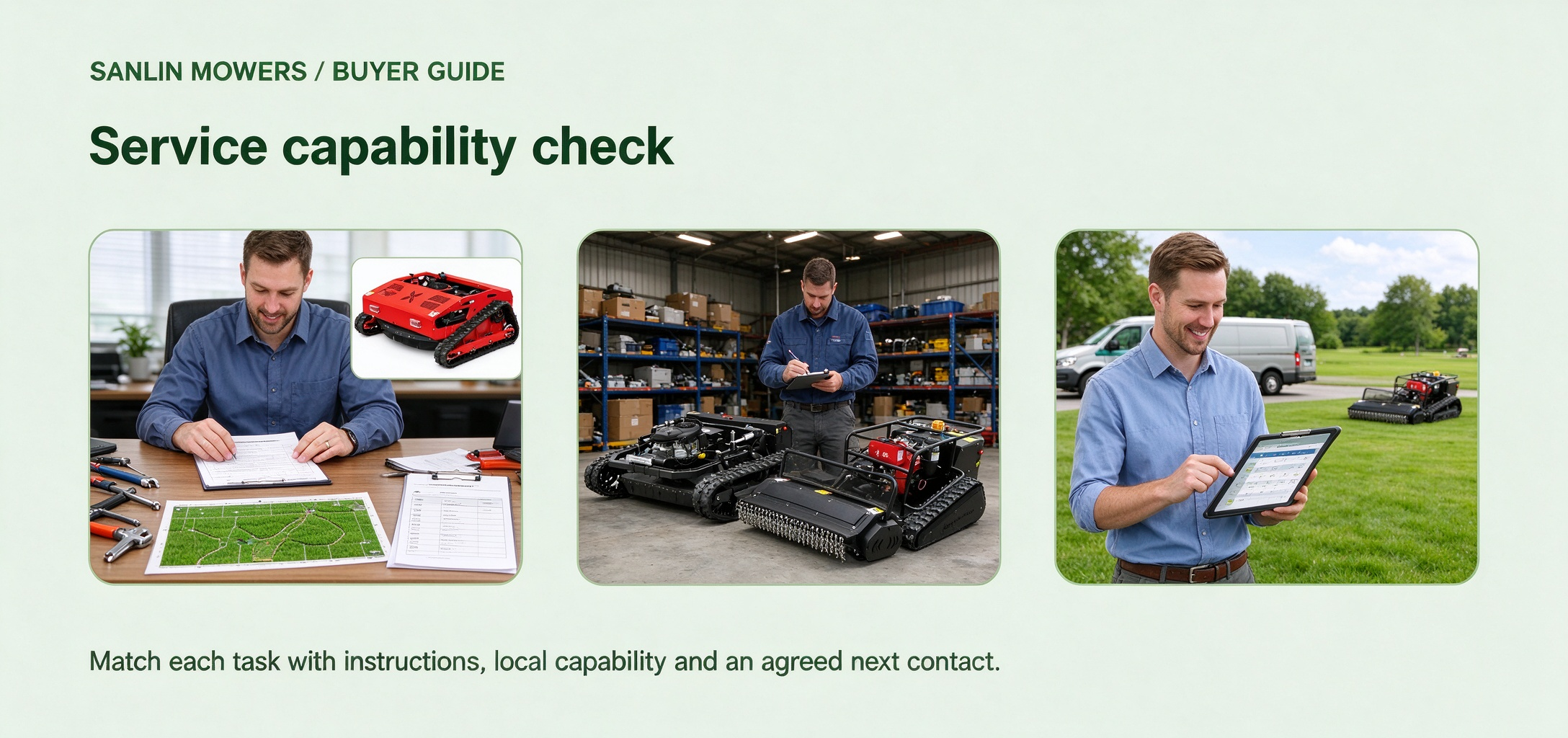
Match each task with instructions, local capability, and an agreed next contact.
Publish only the coverage the dealer can explain
Before sales staff describe service coverage to a customer, prepare a short internal statement for each location or customer group. It should identify the machines covered, the available contact route, the tasks handled locally, any qualified partner arrangement actually agreed upon, and the questions that still require assessment. If the scope differs by model, say so. Avoid translating a parts list or a phone number into a blanket promise of repair, on-site attendance, or a particular turnaround. A customer should be able to understand what the next step is when a specific machine needs attention.
Revisit the statement after the first deliveries, when a new configuration enters the range, or when the service team and customer geography change. The conclusion is a bounded coverage plan that the dealer can support with named responsibilities and current instructions. It is not a universal guarantee for every site or fault. Buyers preparing a distribution enquiry can share the intended territory and service capability so unresolved support questions are discussed alongside the selected model, rather than appearing only after the first customer handover.
Take the next step for your project
Planning dealer coverage for a proposed mower range? Share the selected models, intended customer locations, and the tasks your local team can handle so model-specific service and documentation questions can be discussed.