

Segment the Site into Actionable Work Zones
A professional solar site vegetation enquiry requires a precise operational map, not just a gross acreage figure. Segment the terrain into distinct work zones: open lanes, equipment boundaries, perimeter strips, drainage features, and strict exclusion zones. For each, define the target vegetation, desired clearance outcomes, and mowing frequency. Collaborate with the site team to map transit routes, access gates, and areas with overlapping maintenance activities. This granular approach allows buyers to evaluate a proposed remote-control mower for specific, viable tasks—avoiding the trap of blanket "whole-site" performance assumptions.
Leverage your initial product research to identify candidate machine categories, but leave the final model and track configuration open until the supplier validates the specs. Remember: a marketing description is not a site-specific operational approval. If dimensional data or local site protocols are missing, flag that zone as 'pending assessment' rather than gambling on generic performance claims. The initial deliverable must be a unified zone list accessible to procurement, operations, and the supplier. It must clearly outline confirmed data, missing measurements, and the stakeholders responsible for validating local constraints.
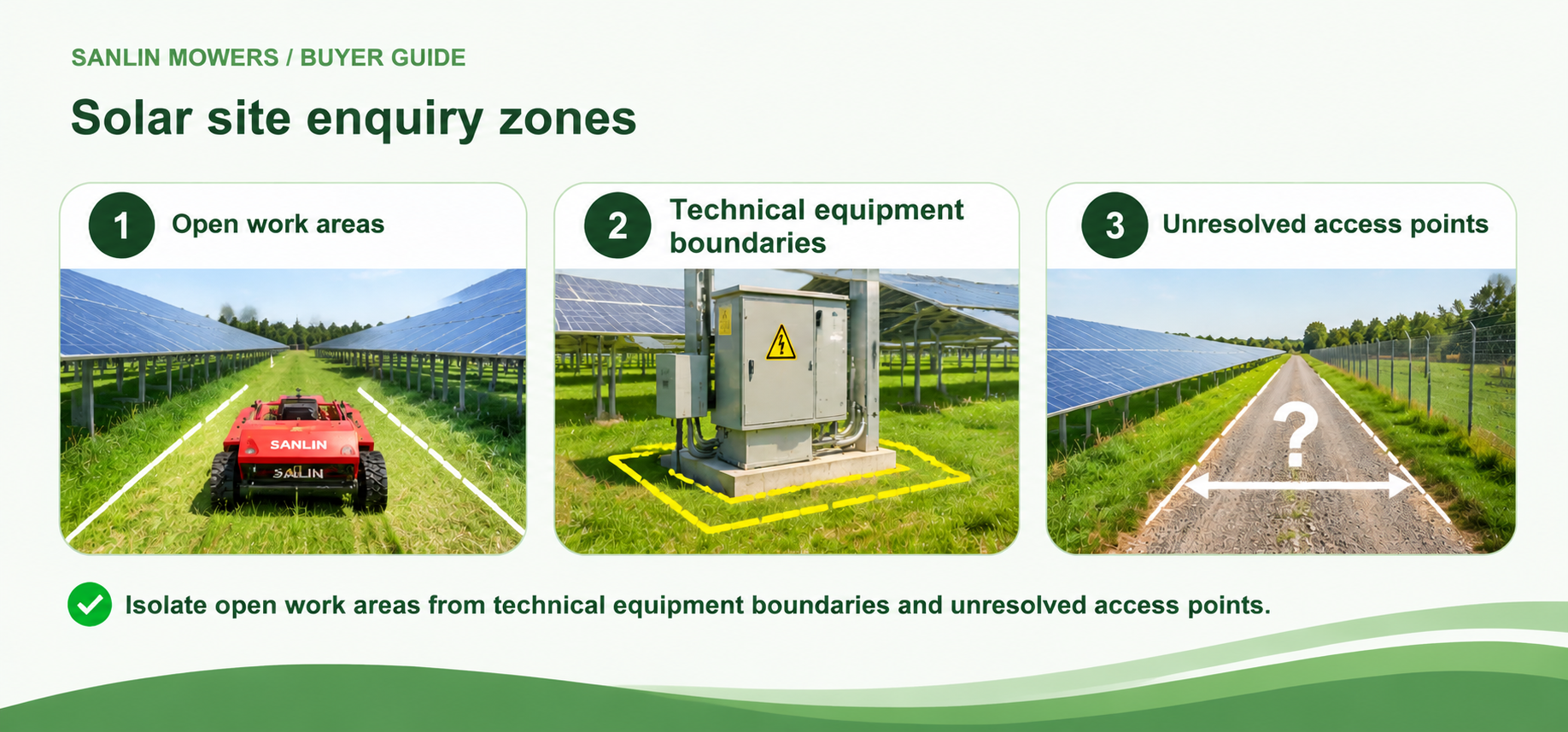
Isolate open work areas from technical equipment boundaries and unresolved access points.
Document Access, Operator Visibility, and Exclusion Zones
For every defined work zone, meticulously map the entry/exit routes, terrain transitions, fixed solar infrastructure, exposed cabling, and blind spots where an operator's line of sight is compromised. The onsite team must proactively establish their own exclusion zones and safety protocols. Deploying a remote-controlled tracked mower does not eliminate the need for rigorous site hazard assessment. Demand supplier documentation on the model’s operating limits, emergency stopping, and recovery procedures. Keep any unverified areas strictly outside the trial scope. Never accept a headline slope-rating or a generic promotional photo as proof of local site suitability.
Best practices for remote-control tracked mower procurement dictate evaluating terrain, vegetation density, access, and operating patterns before comparing machine configurations. Apply this methodology on a zone-by-zone basis, not site-wide. Wherever a solar array row, panel edge, or inverter pad narrows the path, demand exact machine dimensions and track configurations for clearance review. If the operations team cannot guarantee line-of-sight or safe routing under their safety protocols, that zone remains disqualified for now. Treat this article as a procurement preparation framework, not a substitute for hands-on site risk assessment or operational authorization.
Frame a Controlled Trial Around Measurable KPIs
When stakeholders agree to an on-site trial, select a highly representative zone and establish clear, measurable questions to answer. Key Performance Indicators (KPIs) should cover: spatial access under real conditions, post-cut vegetation quality, sustained operator visibility, and transit efficiency between zones. Specify the exact mower model, track type, and flail/blade configuration being tested. Mandate a review of the operational manual and strict adherence to site safety protocols before starting. A valid trial requires baseline starting conditions and a strict log of excluded areas—otherwise, a successful pass in a wide-open lane might be dangerously misinterpreted as a green light for tight, high-risk panel rows.
Log empirical observations strictly; avoid inflating them into generalized marketing claims about max speed, total acreage capacity, extreme slope climbing, or projected financial savings. Document micro-changes in terrain, vegetation types, operational interruptions, and unresolved technical questions. If a supplier swaps the model or attachment, reset the evaluation process—do not auto-transfer previous approvals. This localized data allows the buyer to benchmark the proposed machine directly against the specific zone and current manual labor methods. Hard, zone-specific evidence drives far better procurement leverage than a broad, unsubstantiated claim that one mower handles all solar sites.
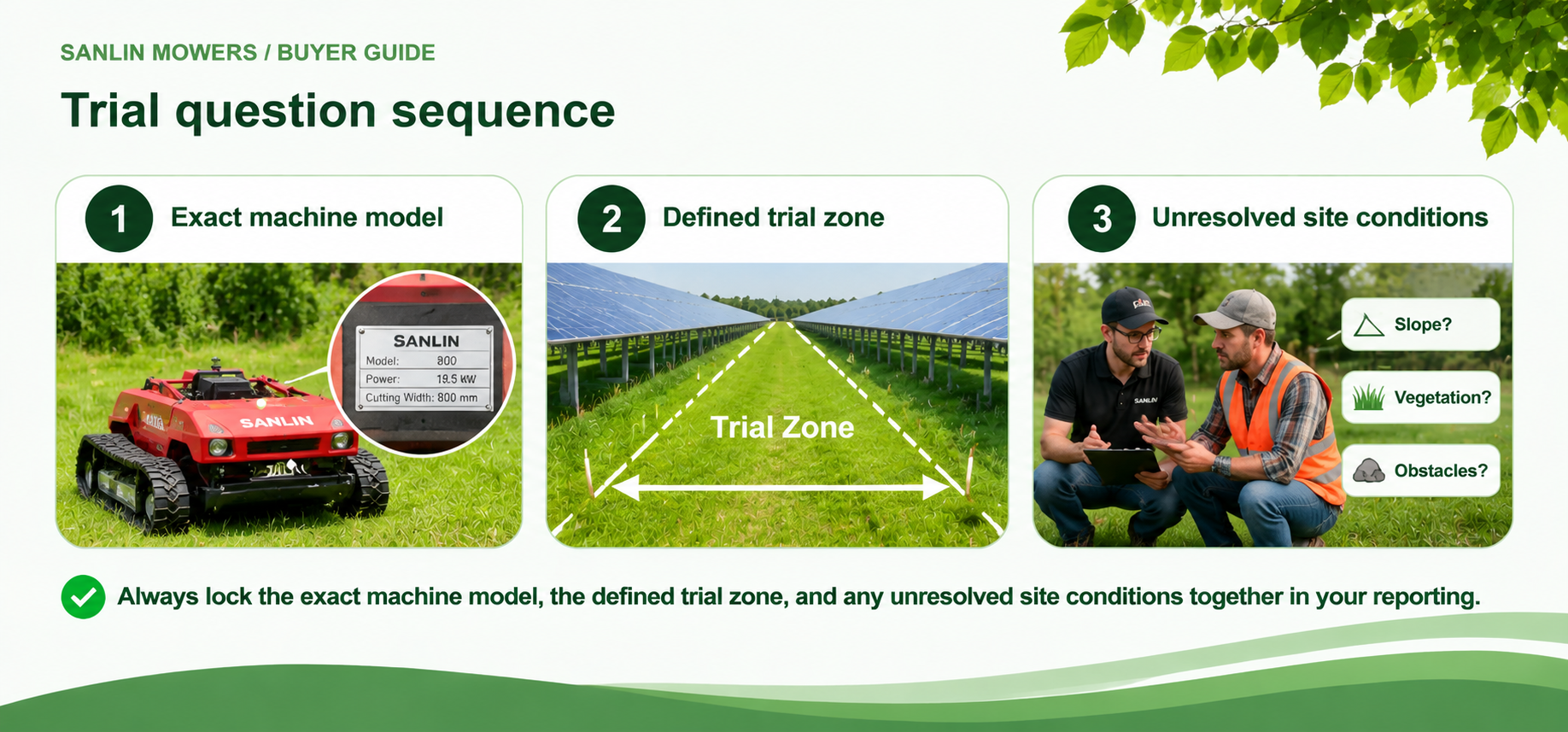
Always lock the exact machine model, the defined trial zone, and any unresolved site conditions together in your reporting.
Convert the Site Map into a Targeted Procurement Enquiry
A high-converting B2B equipment enquiry synthesizes your zone list, access/visibility constraints, specific vegetation targets, operational frequency, destination market, and projected unit volume. Demand model-specific track configurations, technical operating manuals, compliance documentation, and a clear plan for routine maintenance and spare parts logistics. Clearly define who owns the technical site review and who owns the commercial negotiation. Never assume a safety certificate, optional attachment, or warranty arrangement applies universally across all configurations. Keep unresolved operational variables strictly tied to their specific zone and machine choice so the supplier’s response can be accurately scrutinized.
Your conclusion must be a bounded, actionable decision matrix: outlining which zones are cleared for further testing, which require deeper site topography data, and which technical questions the supplier must resolve before a purchase order can be considered. This framework does not automatically declare a Sanlin product suitable for every solar facility. Instead, it equips the buyer with a disciplined, risk-mitigated procurement strategy to identify the right machine, execute a safe trial, and prevent critical safety or aftermarket service terms from getting lost inside a generic Request for Quote (RFQ). Continuously update this brief if the solar site layout, vegetation profile, or selected mower configuration evolves.
Next Steps for Your Solar Vegetation Project
Evaluating remote-control mower equipment for a commercial solar site? Share your mapped work zones, target vegetation profiles, access limitations, anticipated operating schedules, and destination market. This ensures the precise model, configuration, and compliance documentation can be reviewed before you commit to a trial or final order.
Discuss a solar site mower enquiry