

Define the journey before comparing machines
A contractor who moves a remote mower between properties should describe the transport journey as part of the buying brief. List the usual departure point, vehicle or trailer under consideration, number of machines per trip, destination types and frequency of moves. Separate the road journey from loading, restraint, arrival and unloading. Each stage has different questions and different people responsible for it. A machine that appears suitable for vegetation work may still be impractical for a particular vehicle, gate or unloading location. Keep those issues visible before choosing a model or assuming that a fleet can share one transport arrangement.
Start with the public product range to identify possible mower categories, then request dimensions and transport mass for the exact proposed model and configuration. Record attachments, batteries or other items that may travel separately, without guessing how they are packed. Give the transport planner the actual vehicle details and loading equipment information. The result should be a short journey map with known measurements, missing measurements and named reviewers. It is a procurement preparation tool; it is not a loading instruction or proof that a particular combination is permitted on a road.
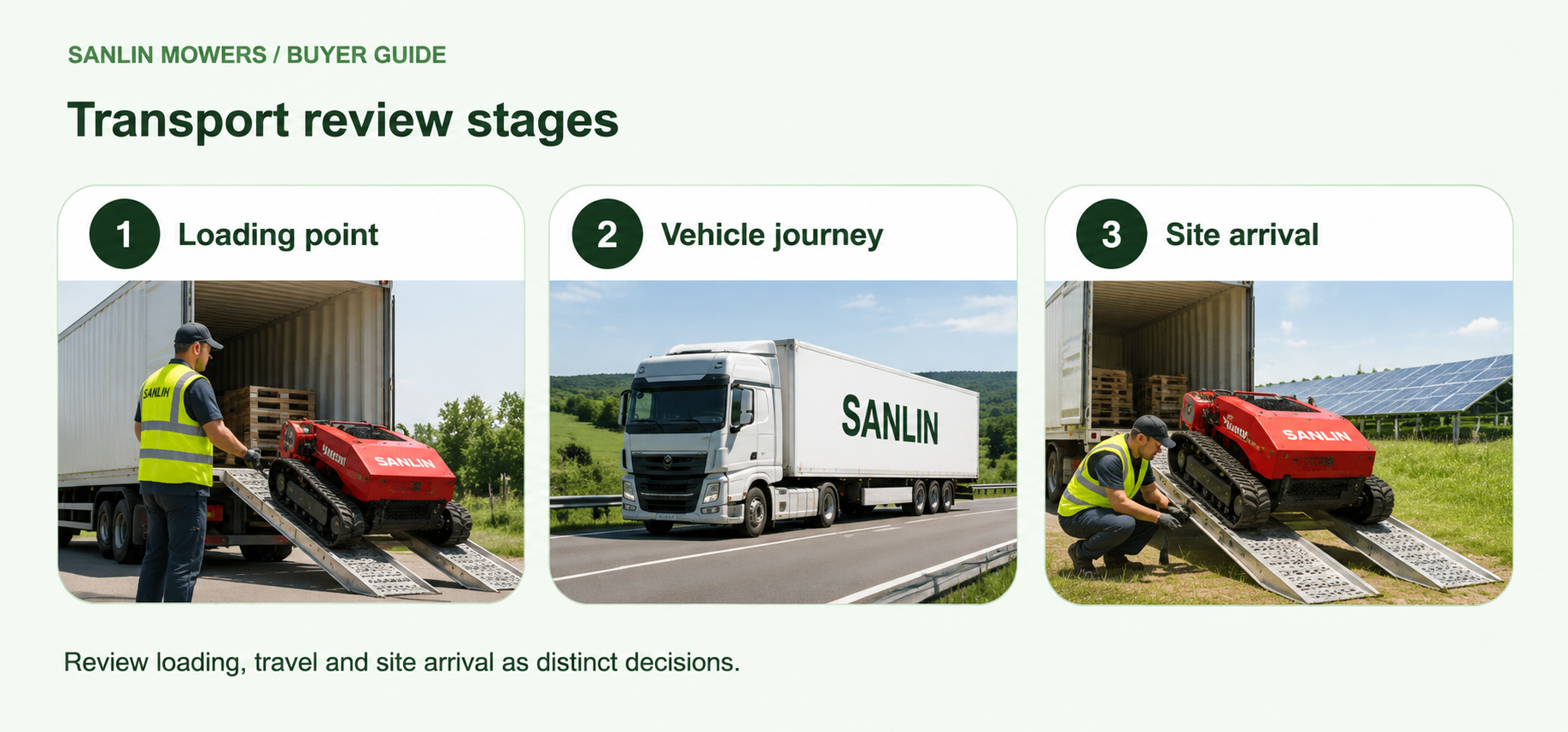
Review loading, travel and site arrival as distinct decisions.
Check vehicle fit and loading arrangements separately
Ask the vehicle owner or competent transport planner to compare the proposed machine's confirmed size and mass with the vehicle, trailer, loading surface and available space. Include the route from storage to the loading point, any turning area and the position of nearby people. A photograph of another operator's setup cannot establish fit for this one. The buyer should request the applicable model instructions and identify any supplier guidance on handling, securing and transport. Where the information is incomplete, do not replace it with an estimated figure from a different model or assume that an attachment has no effect.
The guide to choosing a remote-control tracked mower focuses on matching the machine to terrain, vegetation and operating conditions. Add transport as a separate decision gate: who approves the vehicle combination, who supplies the loading equipment, and which written instructions govern the exact machine. Record the restraint method and legal checks as questions for the responsible local specialist rather than giving a universal recipe. If a vehicle, ramp or surface is still undecided, mark transport readiness as pending. This prevents a product shortlist from being mistaken for an approved loading plan.
Map arrival and unloading at representative sites
A fleet journey does not end when the vehicle reaches the gate. Select two or three representative destinations and record entrance width, available stopping space, ground condition at the proposed unloading point, pedestrian or vehicle movements and the route to the work zone. Ask the site owner or manager which areas are available and which are restricted. Conditions can differ between a depot, orchard and maintenance site even when the same mower is carried. If unloading would interfere with public or site traffic, that constraint needs a local plan before the route is accepted.
Use a simple arrival diagram showing the vehicle position, proposed unloading area and route to the work area. Keep uncertainties on the diagram rather than hiding them in a general statement that access is adequate. The site team should review its own procedures, the vehicle arrangement and the mower instructions together. Weather, soft ground or a changed entrance may invalidate a previously considered location. This article does not authorize an unloading operation; the purpose is to expose the site-specific questions that a buyer must settle before promising routine deployment.
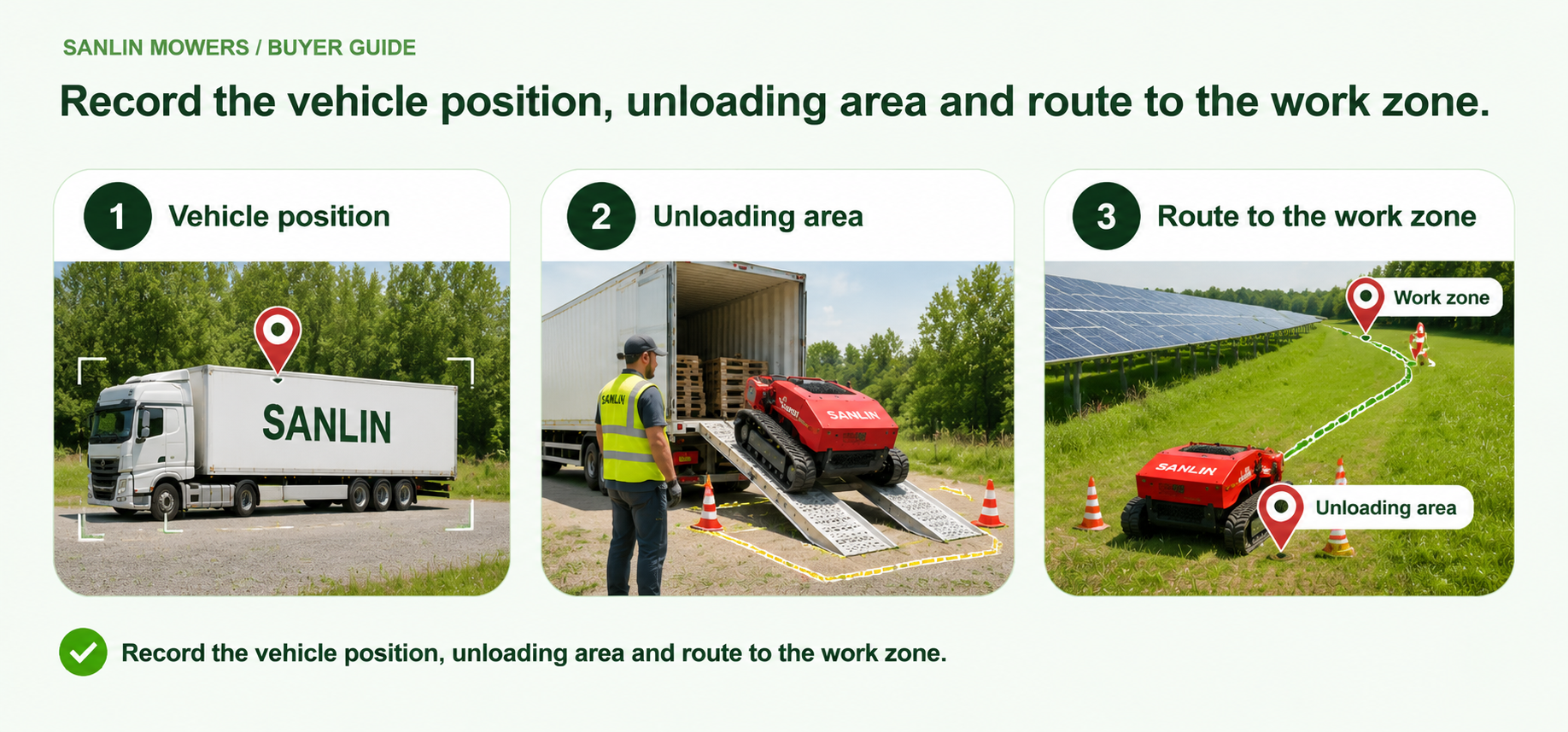
Record the vehicle position, unloading area and route to the work zone.
Turn unresolved checks into an order decision
Before an order, bring the machine supplier, transport planner and site operator back to the same checklist. Confirm the exact model and configuration, the documents requested, the proposed vehicle and the sites represented in the review. Mark each question as confirmed, awaiting evidence or outside the proposed scope. Ask who would handle a change in machine, attachment, vehicle or destination. The buyer may decide that one configuration needs further review or that a different logistics arrangement is required. Neither conclusion should be hidden behind a generic statement that the mower is portable.
The useful output is a bounded decision record: which transport arrangement has been reviewed, what remains open and what evidence is needed before the first move. Keep the operational instructions with the people responsible for using them, and keep commercial discussions tied to the actual configuration being considered. A sales page alone cannot establish road compliance, loading safety or suitability for every site. If the journey cannot yet be described clearly, continue the review before treating a mower shortlist as a deployable fleet plan.
Next step for your project
Planning transport for a remote mower fleet? Share the proposed model, vehicle arrangement, loading equipment and representative destination conditions so the missing product information and site questions can be reviewed before an order.